
Permits & Placement
Driveway Protection During Dumpster Delivery
How LWB protects Frederick driveways during dumpster delivery with boards under every rail, smart morning timing around Maryland's heat, freeze-thaw winters, and careful, no-pivot container placement.
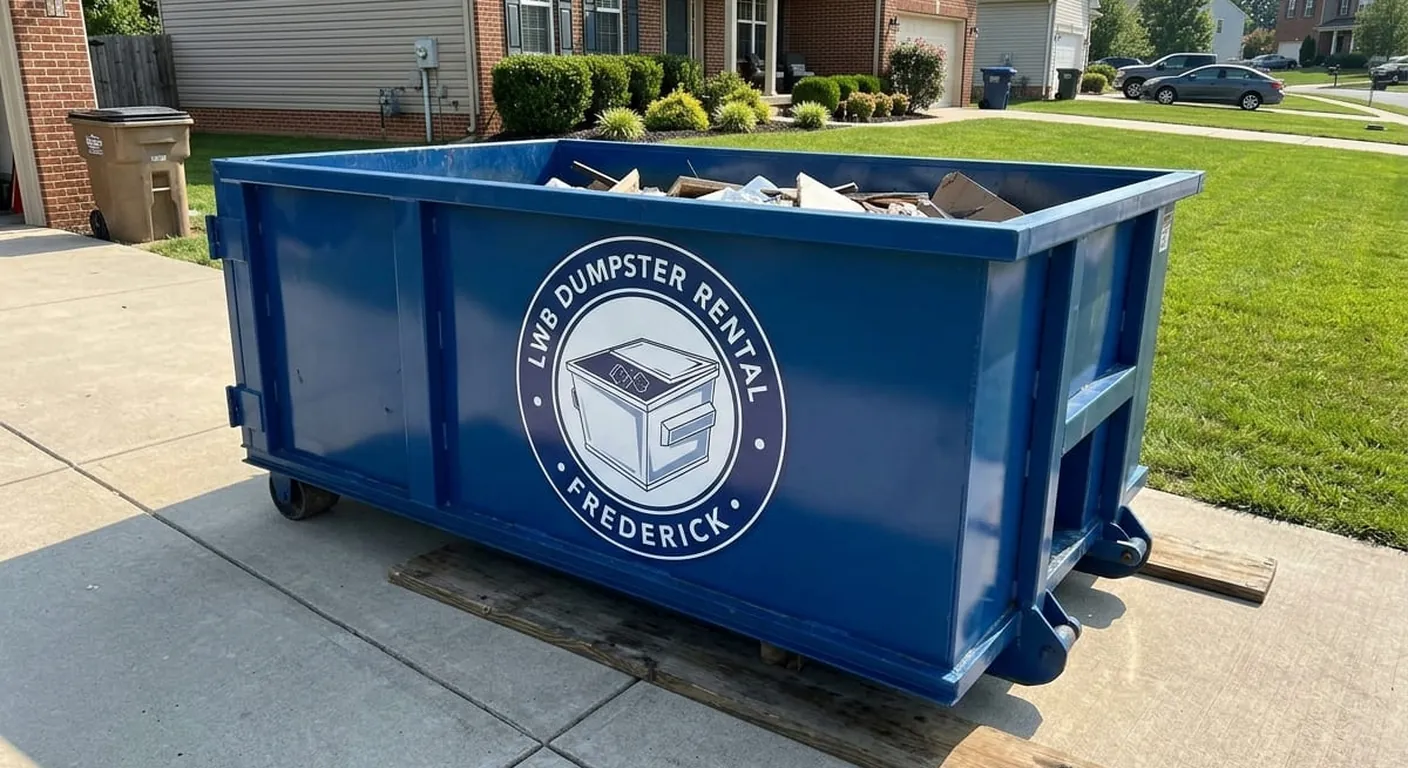
Every residential drop LWB Dumpster Rental Frederick makes starts with the same question from the driver: where's the surface changing, and how much wood do we need to lay down first? That's not a courtesy add-on you have to ask for. Boards or plywood sheets go under the container's steel rails on every residential placement, at no charge, before the truck ever tips a dumpster onto your driveway. It's standard procedure, not an upsell, because a scraped or cracked driveway costs everyone more time and money than a five-minute setup step.
Still, "we protect it" isn't the same as "nothing can go wrong." A steel container dragged and set down on asphalt or concrete puts real, concentrated weight on a small footprint, and Frederick's driveways run the gamut from brick-era downtown slabs to freshly poured concrete in Urbana and Ballenger Creek. What actually protects your surface is a combination of the right gear, the right timing, and a driver who knows how to place a box without gouging or pivoting on the spot. Here's what's actually happening under that container, and what you can do on your end if you're nervous about a particular driveway.
What driveway protection actually means on delivery day
When the truck arrives, the crew looks at the drop zone before anything moves. On a driveway, boards go down first — typically continuous runs of plywood or dimensional lumber laid under the path the container's rails will travel, not just where it finally rests. That matters because most of the damage that happens with careless placement isn't from the dumpster sitting still, it's from the container sliding a few inches while it's being set down or picked back up. Spreading the load across boards keeps the steel rails from ever touching the pavement directly and distributes the weight over a wider area instead of concentrating it on a few square inches.
This is included with every residential delivery LWB does — you don't need to request it, and it isn't a line item added to the flat-rate price. If you have a specific worry (a hairline crack right where the box will sit, a driveway that's only a few weeks old, a paver surface instead of solid concrete or asphalt), say so when you book or when the driver arrives. Extra boards, a slightly different placement, or setting the container on the yard or street instead are all things worth discussing before delivery, not after. See residential dumpster rental for how placement gets scoped for houses generally, and roll-off dumpster rental for how the roll-off truck itself handles delivery and pickup mechanics.
Hot, humid summers and soft asphalt
Central Maryland summers get hot and sticky, and asphalt is genuinely softer on a 90-degree August afternoon than it is at 7am. Asphalt is a petroleum-based product — it doesn't melt, but it does lose some of its rigidity as pavement temperatures climb, especially on a driveway that's had sun on it all day. A container's rails resting on softened asphalt, especially if it sits for a full 7-day rental, is more likely to leave an indent than the same container on the same driveway at 60 degrees.
This is the single biggest reason morning delivery is worth requesting in summer. If you're scheduling a drop for July or August, ask for an early slot. Boards still go down regardless of the hour, but placing the container while the asphalt is cooler and firmer — then letting it sit through the heat of the day already spread across wood, not bare rail — meaningfully reduces the odds of a rail impression. If your driveway is asphalt and less than a year or two old, it's worth mentioning that specifically when you book; newer asphalt hasn't fully cured and is softer than pavement that's had a season or two to harden. The Maryland Department of Transportation notes similar seasonal pavement behavior on public roads, and the same physics apply at driveway scale.
Freeze-thaw winters
The flip side shows up in January and February. Frederick's freeze-thaw cycle — ground freezing, thawing, refreezing, sometimes several times in one month — is hard on any pavement, and it's already doing damage before a dumpster ever shows up. Water gets into hairline cracks, freezes, expands, and widens them a little more each cycle. A driveway with existing freeze-thaw cracking is more vulnerable to a heavy point load simply because the surface underneath is already compromised, not because cold pavement itself is soft the way hot asphalt is.
Cold asphalt and cold concrete are both more brittle in winter, which cuts the other way from summer risk: instead of denting, a compromised slab is more likely to crack further along a stress line that's already there. Boards under the rails help either way, spreading weight past the weak point instead of concentrating it on one crack. If you know your driveway has visible freeze-thaw damage, flag it before delivery so the crew can plan placement around the worst of it.
Older concrete in historic Frederick vs. newer HOA driveways
Downtown and the older in-town neighborhoods around Frederick's historic core have driveways and aprons that have been through decades of freeze-thaw cycles, tree roots, and prior patch jobs. Existing cracks, uneven slabs, and narrow alley-style access are common. None of that rules out a delivery, but it does change the calculus: a driver setting a container on a driveway that already has movement in it needs to place boards to bridge the worst cracking, not just cover the footprint, and may recommend a slightly different spot — the street apron instead of deep in a narrow alley, for instance, if permit rules allow it.
Newer subdivisions like Urbana, Ballenger Creek, Spring Ridge, and Wormans Mill usually have driveways poured in the last decade or two, with fewer existing cracks but a different concern: many of these communities have HOA covenants about how long a container can be visible from the street, and homeowners here tend to be more protective of a driveway that still looks close to new. The pavement itself is often in better structural shape, but a fresh, unblemished surface makes any mark — even a light one that would go unnoticed on an older slab — much more visible. Check your covenant on timing before you book, and mention a newer pour to the crew so they know to be extra careful with placement.
Placement and pivot technique
Most driveway damage that isn't about temperature comes down to technique during setup or pickup, not the weight of the container sitting still. A roll-off truck backs in, and the container slides off rails at an angle, then gets winched into final position. If a driver has to pivot or drag the box sideways to square it up — instead of getting the truck angle right on the first pass — that's when rails scrape rather than roll, and that's what leaves gouges rather than just a light impression.
An experienced crew reads the driveway's width, slope, and any obstacles (a mailbox post, a slight curve, a narrower apron near the street) before backing in, and adjusts truck position rather than fighting the container into place once it's down. Boards help absorb some of this regardless, but the real protection is a driver who gets the angle right the first time. If your driveway has a tight turn or a slope, mention it when you schedule — it helps the dispatcher send a rig that can approach at the right angle instead of improvising on arrival.
Worried about a fresh sealcoat or a brand-new driveway?
If your driveway was just sealcoated or poured within the last few weeks, say so before delivery, not after the truck is already in your driveway. Fresh sealcoat typically needs a curing window before it can handle heavy point loads without tracking or scuffing, and newly poured concrete needs real cure time — often measured in weeks — before it reaches the strength stamped concrete is rated for. Options worth discussing with LWB in that situation include:
- Scheduling delivery for after the manufacturer or contractor's recommended cure window has passed.
- Placing the container on the street or yard instead of the driveway, where permit rules and space allow.
- Extra boards or a different placement spot on the driveway that avoids the newest or most sensitive section.
None of this needs to be figured out on the fly. A quick mention when you book — "the driveway was sealcoated three weeks ago" or "we just had it poured in June" — gives the office time to plan around it instead of reacting to it curbside. If you're considering street placement instead, keep in mind that private-property placement in a driveway or yard typically doesn't need a permit, while public street or right-of-way placement may require one through City of Frederick — worth checking before you settle on that as your backup plan.
Driveway surface type: risk and recommended precaution
| Surface type | Risk level | Recommended precaution |
|---|---|---|
| New asphalt (under 1 year) | Higher in summer heat | Morning delivery, boards under full rail path, avoid peak afternoon sit time if possible |
| Established asphalt (1–10 years) | Moderate | Standard boards, morning delivery preferred in summer |
| Older concrete with existing cracks (historic Frederick) | Moderate to higher | Boards bridging cracked sections, discuss alternate placement if cracking is severe |
| Newer poured concrete (HOA subdivisions) | Lower structurally, higher cosmetically | Standard boards, confirm HOA visibility timeline, flag if poured within recent weeks |
| Fresh sealcoat (under 30 days) | Higher | Confirm cure time before booking, consider street/yard placement |
| Gravel or paver driveway | Variable | Discuss surface type when booking so the crew plans placement and boards accordingly |
These are general patterns, not guarantees for any specific driveway — every slab and every pour has its own history. If you're unsure which row your driveway falls into, describe it when you call and let the office and driver weigh in.
Sizing and placement go together
Part of protecting a driveway is picking a container that actually fits the space without forcing an awkward placement or a longer stretch of pavement under load. A 10 or 15 yard container has a smaller footprint than a 30 or 40, and on a shorter or narrower driveway, right-sizing the box can mean the difference between a clean straight-in placement and one that requires more maneuvering. Compare footprints and typical uses on the dumpster sizes page before you book, especially if your driveway is on the smaller or more irregular side.
What to do if you notice a mark after pickup
Even with boards and careful placement, pavement is pavement — a very faint impression is possible on soft summer asphalt, the same way a heavy delivery truck or a parked car can leave one over time. If you notice anything after pickup that concerns you, call the office and describe what you're seeing. Most light marks on asphalt from a properly-boarded delivery fade within days as the surface re-settles; anything that looks like an actual gouge or crack is worth flagging right away so it can be looked at while the details of the delivery are still fresh.
Getting it right from the first call
The best driveway protection starts before the truck ever leaves the yard: telling the office what surface you have, how old it is, whether it's been sealed or poured recently, and whether there's a tight turn or slope to plan around. Combined with standard boards under the rails on every residential drop and a driver who places the container correctly the first time, that's what keeps a dumpster rental from leaving any trace behind. If you're planning a delivery in Frederick, Urbana, Ballenger Creek, or anywhere nearby and want to talk through your specific driveway before booking, call LWB Dumpster Rental Frederick at (240) 549-6718 and describe the surface — the team can tell you what precautions make sense before the truck ever shows up.
Need a container in Frederick or anywhere in Frederick County? Call (240) 549-6718 and describe the job. We will name the size, the flat rate and a delivery slot — often the same day. No forms, no waiting on an email.